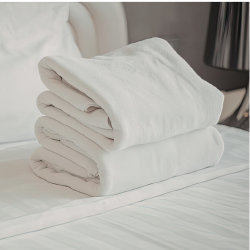
500 GSM 100% cotton hotel towels, woven with 20/2 ring-spun yarn in warp and pile, and 16/1 ring-spun in the weft. The edges — double-stitched hem. This is the line we call in practice the "sweet spot" of the hotel market — the balance between feel, longevity and operating economics where 500 GSM is the working standard for the larger part of the 4-star segment in Europe.
The difference with economy terry lines under 450 GSM is not only the weight. At 500 GSM the pile is built with two-ply 20/2 yarn, not the standard 16/1. This is a quiet but tangible technical step that shapes how the towel behaves after the first 50–100 wash cycles.
Why 500 GSM is the "sweet spot"
In terry lines there are three critical threshold levels the market recognises: 400 GSM (economy), 500 GSM (mid-to-upper-class standard) and 700 GSM (premium SPA). There are many steps in between, but these three are the market anchors.
500 GSM is the working grammage because it covers four expectations at once:
- •Visible weight in the guest's hand — the towel doesn't "fly" when picked up; it gives the density that is subconsciously read as "quality".
- •Fast drying — important for hospitality. Denser 600–700 GSM towels require a longer dryer cycle, which loads energy costs. 500 GSM dries 20–25% faster.
- •Reasonable purchase price — the premium over 444 GSM is about 18–25%, while the step up to 600 GSM adds another 30–40%. 500 GSM stays in the zone where the math works for the hotel.
- •High residual absorbency after 200 cycles — this is where the gap to economy lines becomes visible. The 20/2 construction in the pile holds absorbency significantly longer.
In our practice, when a hotelier upgrades the property from 3 to 4 stars or undertakes a serious renovation, swapping 400 GSM for 500 GSM is one of the first changes in the linen inventory. The guest feels the difference immediately, and ROI is measurable within the first 6 months through reviews and repeat bookings.
The 20/2 construction in the pile — what it changes
This is where the most important technical difference versus economy lines hides. 20/2 yarn is two-ply — two finer threads (count 20) twisted together into one stronger, balanced yarn. The result is:
- •More stable loops — they don't fray or "fall" in the middle of the towel under intensive laundering.
- •A more uniform surface — without the characteristic "matted" zones that appear in single-ply piles after 80–100 cycles.
- •Better response to abrasion — a bathroom towel contacts rough surfaces (tiles, wall textures, sometimes metal fittings). A 20/2 pile takes this far better.
This is the difference that doesn't show on the spec sheet but does show in the hotel's books after 18 months in service.
Which properties it suits
We recommend 500 GSM terry towels for:
- •4-star hotels — as the standard across all rooms, with no differentiation between room types.
- •Business and conference hotels — where the guest travels for work and expects steady quality without overexposed luxury.
- •Premium aparthotels and holiday residences — especially in tourist destinations where the guest compares with competing properties in the same class.
- •Mid-level wellness and SPA centres — as the primary towel in changing rooms and relax zones (for SPA treatments we recommend 600+ GSM).
- •Boutique apartments and Airbnb Plus properties — where the quality of bathroom textile is an element of the guest experience.
For 5-star hotels and luxury SPA residences we recommend 600 GSM lines and above. For 3-star properties and hostels — the 444 GSM or 400 GSM line, depending on the budget.
Care and longevity
Washing and drying at 60°C — full coverage of EU sanitary standards. Under correct treatment, 500 GSM terry towels keep a premium appearance for 220 to 260 cycles — about 40 cycles more than the 444 line, thanks to the 20/2 construction in the pile.
Maintenance recommendations:
- •No fabric softener — softener coats the loops with a film that reduces absorbency by 25–40%. A terry towel without softener absorbs faster and more efficiently.
- •Wash separately from coarse fabrics — sheets and towels rubbing together in one drum cuts the life of both items.
- •Don't overload the drum — freedom of movement in the washing machine determines wash quality and loop longevity.
Colour and finish
The standard execution is Optical white — the universal hotel standard that allows aggressive laundering and hygiene control. On request we produce other colours for design-led projects, but under industrial laundering white remains the most practical solution.
Comparison within the group
| Series | GSM density | Material | Color | Pile |
|---|---|---|---|---|
| → Towels 500 | 500 | 100% Памук | Оптично Бяло | 20/2 Ринг |
| Towels 665 | 665 | 100% Памук | Оптично Бяло | 20/2 Ринг |
| Towels 550 | 550 | 100% Памук | Оптично Бяло | 20/2 Ринг |
| Towels 444 | 444 | 100% Памук | Оптично Бяло | 16/1 Ринг |
Frequently asked questions
What is the real difference between 444 GSM and 500 GSM in practice?
Two important points: hand feel (about 12% denser) and working life (about 20% more cycles at a premium appearance). On a similar per-square-metre cost basis, 500 GSM often works out more economical long-term.
Are they suitable for SPA treatments?
For massage and treatments we recommend 600+ GSM, because the client lies on the towel for longer and density is part of the feel. For changing rooms, poolside and relax zones, 500 GSM is suitable.
What sizes do you offer?
Standard hotel sizes: 30×50 cm (face), 50×100 cm (mid), 70×140 cm (bath) and 100×150 cm (large bath sheet). Non-standard sizes available above a minimum quantity.
Is embroidery and branding possible?
Yes — a woven jacquard border with the hotel logo, embroidery on the towel, or coloured trim. We recommend branding in the border zone, not on the pile, to preserve absorbency.